Hairline transplant · Macclesfield
Frame the face. Plan beyond today.
A hairline transplant moves selected follicular units from an assessed donor area to the frontal scalp. The operation is only one part of the result: diagnosis, height, irregularity, graft selection, angle, temple integration and future hair loss determine whether the new frame remains believable.
An assessment may lead to medical management first, FUE or FUT surgery, a staged plan, observation—or a recommendation not to transplant.
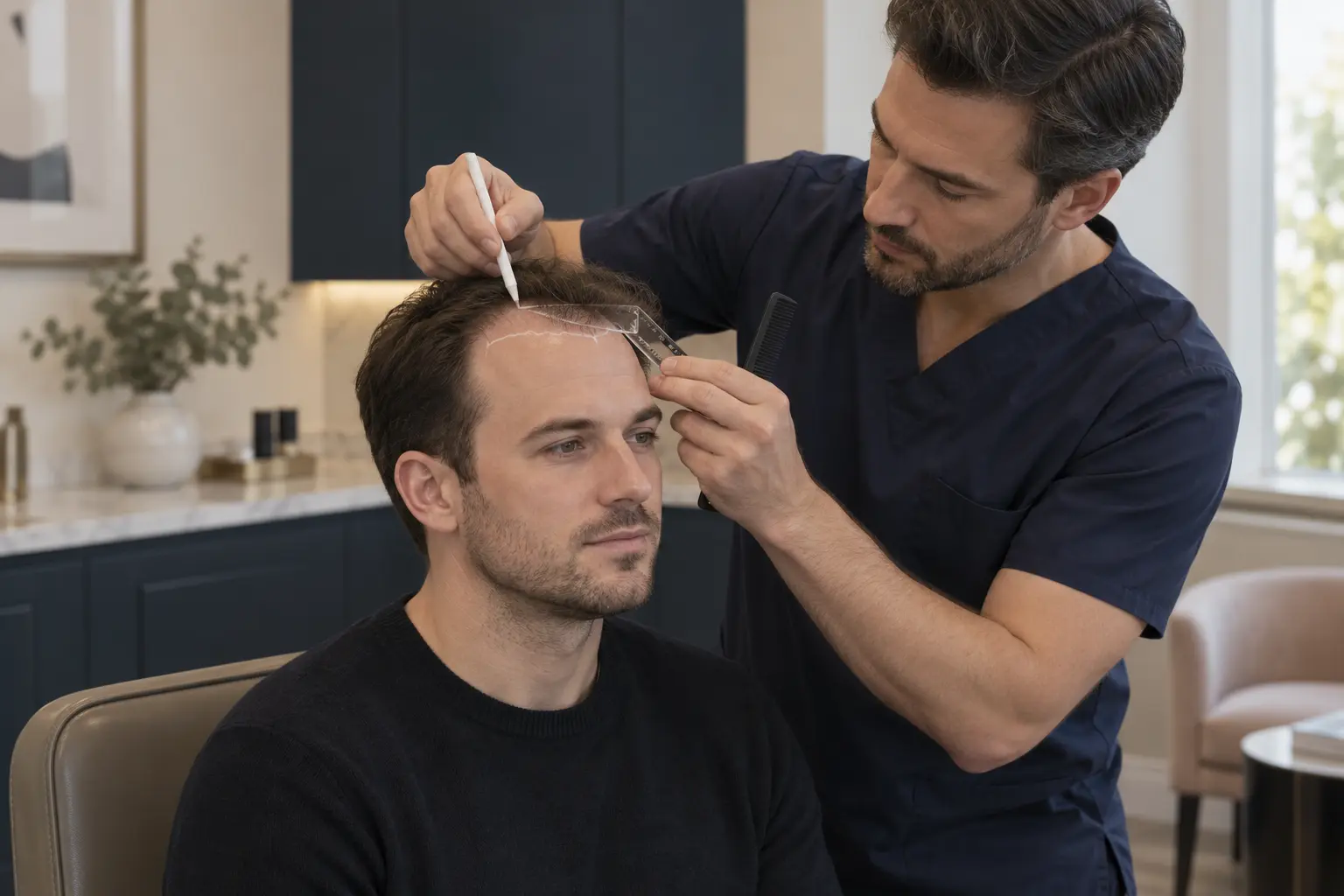
Diagnose before drawing
A receding edge is a symptom—not a diagnosis.
Similar-looking hairlines can arise from different processes. A transplant is appropriate only when the cause, donor stability and likely future pattern make redistribution sensible.
The frontal scalp contains miniaturised native hair, transition zones and temporal junctions that may still be changing. Magnified examination and history are needed before an attractive line is drawn.
Patterned frontal recession
Androgenetic alopecia commonly changes the corners, frontal band and mid-scalp. The apparent edge may not show the full field of miniaturisation.
Assess: pattern and progressionDiffuse frontal thinning
Hair may remain across the front but become progressively finer. Operating through unstable native hair can increase shock-loss and planning risk.
Assess: calibre and densityHigh or asymmetric hairline
A stable naturally high hairline, congenital shape or asymmetry may be considered for transplantation, but forehead-reduction surgery is a different operation with different scars and trade-offs.
Compare: grafting or reductionTraction, scarring or patchy loss
Traction alopecia, inflammatory scarring alopecia, alopecia areata and previous surgery require cause-specific assessment. Active disease may make transplantation unsuitable.
Exclude: ongoing damage or diseaseA low straight line can become a permanent design problem.
The most visible part of a transplant deserves more than a tracing from a photograph. Position, texture and long-term recession must work together.
The procedure, made clear
A hairline transplant rebuilds a transition—not a border.
Follicular units are harvested from a planned donor zone by FUE or FUT and placed into surgeon-created recipient sites. Naturalness depends on the position and contour of the frame, the softness of its leading edge, and how density builds behind it.
Transplanted follicles generally retain characteristics of their donor origin, but not every graft is guaranteed to grow. Native hair behind and around the transplant may continue to thin, so the first design should preserve enough donor and flexibility for the years ahead.
Candidate selection
A stable diagnosis. A usable donor. A hairline that can age.
Suitability is based on the cause and rate of loss, frontal priorities, scalp health, donor quality, previous surgery, hair characteristics and a realistic understanding of coverage, scarring and long-term maintenance.
A hairline transplant may be considered when…
Surgery may be unsuitable or premature when…
A six-part assessment
Diagnose the loss before designing the line.
A useful consultation should explain not only what can be transplanted now, but how the decision affects native hair, donor reserve and future options.
Reconstruct the history
Onset, rate of change, family pattern, symptoms, traction, medical history, medicines, previous treatment and surgery are documented.
Examine the frontal scalp
Magnification helps identify miniaturisation, inflammation, scarring, hair calibre variation and vulnerable native hair behind the visible edge.
Measure the donor
Density, calibre, follicular-unit composition, miniaturisation, previous scars and safe-zone boundaries inform a responsible harvest range.
Map the facial frame
Front, profile and three-quarter views are used to consider forehead height, asymmetry, temporal recessions, temple points and the mid-scalp.
Compare design options
Conservative positions and contours are drawn and reviewed. A digital simulation can support discussion but cannot predict graft survival or density.
Agree the lifetime plan
Medical management, observation, FUE, FUT, staging, donor limits, costs, recovery and what happens if growth is limited are discussed before consent.
Two harvest routes
FUE and FUT supply grafts. Neither designs the hairline for you.
Both routes can provide follicular units for frontal restoration. The choice follows donor anatomy, hairstyle, graft requirement, previous surgery, scarring preference and the long-term harvest strategy.
Important: “DHI” and implanter pens describe aspects of graft placement; they do not create a third source of donor follicles. Naturalness still depends on diagnosis, safe harvesting, graft handling and surgeon-led recipient-site design.
Follicular unit excision
Follicular units are removed individually through small circular donor wounds before being placed into the frontal recipient area.
Follicular unit transplantation
A donor strip is removed and dissected into follicular units before the donor wound is closed.
Three linked design zones
Naturalness is built behind the line—not drawn across it.
Transition zone
The leading edge uses carefully selected single-hair grafts, small irregularities and variable spacing to avoid an abrupt, pluggy border.
Defined frontal zone
Density builds behind the transition using suitable follicular units, with distribution guided by calibre, colour contrast and the graft budget.
Temporal junction
The frontal corners, lateral humps and temple points must connect coherently. Filling every recession or lowering every temple is not automatically appropriate.
If surgery is appropriate
Protect the donor. Build the frame one angle at a time.
The exact surgical sequence varies by harvest and placement method. Consent should identify the operating surgeon, each team member’s role, the proposed graft range, permanent scars, aftercare and the response if growth or density is below expectation.
Reconfirm the design
Diagnosis, medicines, donor boundaries, photographs, frontal height, contour, temporal junctions and consent are reviewed before treatment.
Prepare and anaesthetise
Donor and recipient areas are prepared and local anaesthetic is administered. Any additional medication or sedation is individually assessed and explained.
Harvest conservatively
Follicular units are removed by the agreed FUE or FUT approach while transection, donor distribution and future reserve are monitored.
Inspect and sort
Grafts are examined, protected and organised so fine single-hair units can be reserved for the transition zone.
Create direction and density
Recipient sites establish the planned angle, direction, spacing and contour while respecting existing native hair and scalp blood supply.
Place, check and discharge
Grafts are placed atraumatically, symmetry and flow are reviewed, and written care, medicines, contacts and follow-up are provided.
Healing and growth
The design is visible on day one. The result is not.
Your surgical team’s written instructions take priority. These phases are broad guideposts rather than deadlines; donor healing, shedding, growth and maturation vary.
0–2
Early protection
Redness, tenderness, pinpoint crusting, minor oozing and swelling can occur. Avoid rubbing, pressure and unapproved products.
3–7
Careful cleansing
Crusts remain visible while FUE sites or the FUT closure heal. Washing, sprays, sleep position and dressings follow the clinic’s instructions.
1–2
Surface healing
Crusting usually settles progressively. Non-dissolvable FUT sutures or staples, if used, are reviewed on the surgeon’s schedule.
2–8
Shedding phase
Transplanted shafts commonly shed. Temporary shock loss can also affect native or donor hair, particularly where miniaturisation is present.
3–6
Early growth
New hairs may begin appearing at different times and can initially be fine, uneven or difficult to style. Early images do not predict final density.
10–18
Maturation
Calibre, length, texture and visual coverage may continue to improve. Final review also considers the native hair behind the transplant.
Understand the possible complications.
Hair transplantation is surgery. Careful design reduces avoidable problems but cannot guarantee graft survival, density, symmetry or satisfaction.
Contact the surgical team promptly for severe or increasing pain, active bleeding, marked swelling, spreading redness, discharge, fever, breathing difficulty, visual symptoms or any unexpected deterioration.
Inclusive, individual design
Your identity is not a template.
A hairline can support personal, aesthetic or gender-affirming goals, but it should not be reduced to a standard “masculine” or “feminine” outline. The plan begins with the patient’s language, priorities and desired expression.
Start with the individual goal
Discuss what feels incongruent, what change matters most and which features the patient wants to preserve rather than imposing a generic ideal.
Use anatomy without stereotyping
Forehead height, contour, temples, facial proportions, hairstyle and profile guide design; no one geometry defines a gender.
Account for ongoing biology
Hormones, patterned loss, traction and medical treatment can influence native hair. The transplant plan must remain medically and surgically coherent.
Preserve future choice
A conservative first design and donor reserve leave room for progression, refinement or a change in styling preferences over time.
Your clinical team
Know who diagnoses, designs and operates.
A hairline is an irreversible use of donor hair in the most visible part of the scalp. Your plan should state who is responsible for assessment, extraction, recipient-site creation, graft placement and postoperative review.
Dr Fida Ul Haq
Hair-loss and scalp assessment; long-term planning
Dr M Muhammad
Lead hair transplant surgeon; hairline design
Before you decide: verify each clinician’s current registration and role, ask who performs every surgical stage, and take time to consider the diagnosis, alternatives, graft budget, cost, recovery and material risks without pressure.
Questions worth asking
Clear answers before the frame becomes permanent.
These are general explanations, not personal medical advice. Suitability and a responsible graft range require an in-person clinical assessment.
What is a hairline transplant?
A hairline transplant moves follicular-unit grafts from an assessed donor area to the frontal scalp. Recipient sites are designed to rebuild a gradual transition, appropriate contour and natural direction rather than a sharp drawn border.
Who may be suitable for a hairline transplant?
Potential candidates usually have an established transplantable diagnosis, reasonably predictable loss, a healthy scalp, adequate stable donor hair and realistic expectations. Rapid progression, active scalp disease, alopecia areata, diffuse donor miniaturisation or an unsustainably low requested line can make surgery premature or unsuitable.
How is a natural-looking hairline designed?
Design considers age, facial proportions, profile, forehead height, existing pattern, temporal junctions, hair calibre, curl, colour contrast and future recession. A softer transition commonly uses single-hair grafts, controlled irregularity and low recipient-site angles, with visual density building behind it.
Is FUE or FUT better for a hairline transplant?
Neither harvest method automatically creates a better hairline. Both can supply follicular units and both leave permanent scars. The choice depends on donor anatomy, graft requirement, hairstyle, previous surgery, healing preference and the long-term donor strategy.
Can a transplant lower a naturally high hairline?
It may be possible when the hairline is stable and donor supply, scalp health and the required area are suitable. Hairline transplantation adds follicles without moving the scalp; forehead-reduction surgery advances the existing hair-bearing scalp and creates an incision scar. The two options have different candidacy and trade-offs.
Can hairline transplantation support gender-affirming goals?
It can be considered as part of an individualised plan for trans, non-binary and other patients seeking a different facial frame. The design should follow the patient’s goals, facial proportions, hairstyle, donor capacity and long-term hair-loss biology rather than relying on a rigid gender template.
How many grafts does a hairline transplant need?
There is no responsible universal number. The proposed height and contour, treatment area, existing hair, desired visual change, hair calibre, colour contrast, follicular-unit composition and donor reserve all affect the estimate. Photographs alone are not enough for a final plan.
When will results be visible, and are they permanent?
Transplanted shafts commonly shed in the first weeks. New growth may begin after several months and then gain length and calibre, with maturation often assessed across roughly 10 to 18 months. Donor-derived follicles may persist, but not every graft is guaranteed and surrounding native hair can continue to thin.
How much does a hairline transplant cost?
Cost depends on the diagnosis, harvest method, proposed graft range, design complexity, operating team, facility, aftercare and whether treatment is staged. A written quote should explain what is included, finance terms, possible additional costs and the clinic’s approach if growth is below expectation.
A consultation, not a commitment
Design the future frame before committing a single graft.
Meet the clinical team in Macclesfield for diagnosis, magnified frontal and donor assessment, face-to-scalp mapping, treatment comparison and a realistic long-term graft strategy.
This page provides general information and is not a diagnosis, personalised treatment recommendation or guarantee of outcome.