Advanced donor planning · Macclesfield
Body hair is a reserve.Not a shortcut.
When safe scalp donor supply is limited, carefully selected beard or torso hair may extend the options. But body hair grows, feels and covers differently—so source matching and realistic planning come before graft numbers.
A consultation may lead to a scalp-only plan, staged body-hair testing, combined surgery or a recommendation not to proceed.
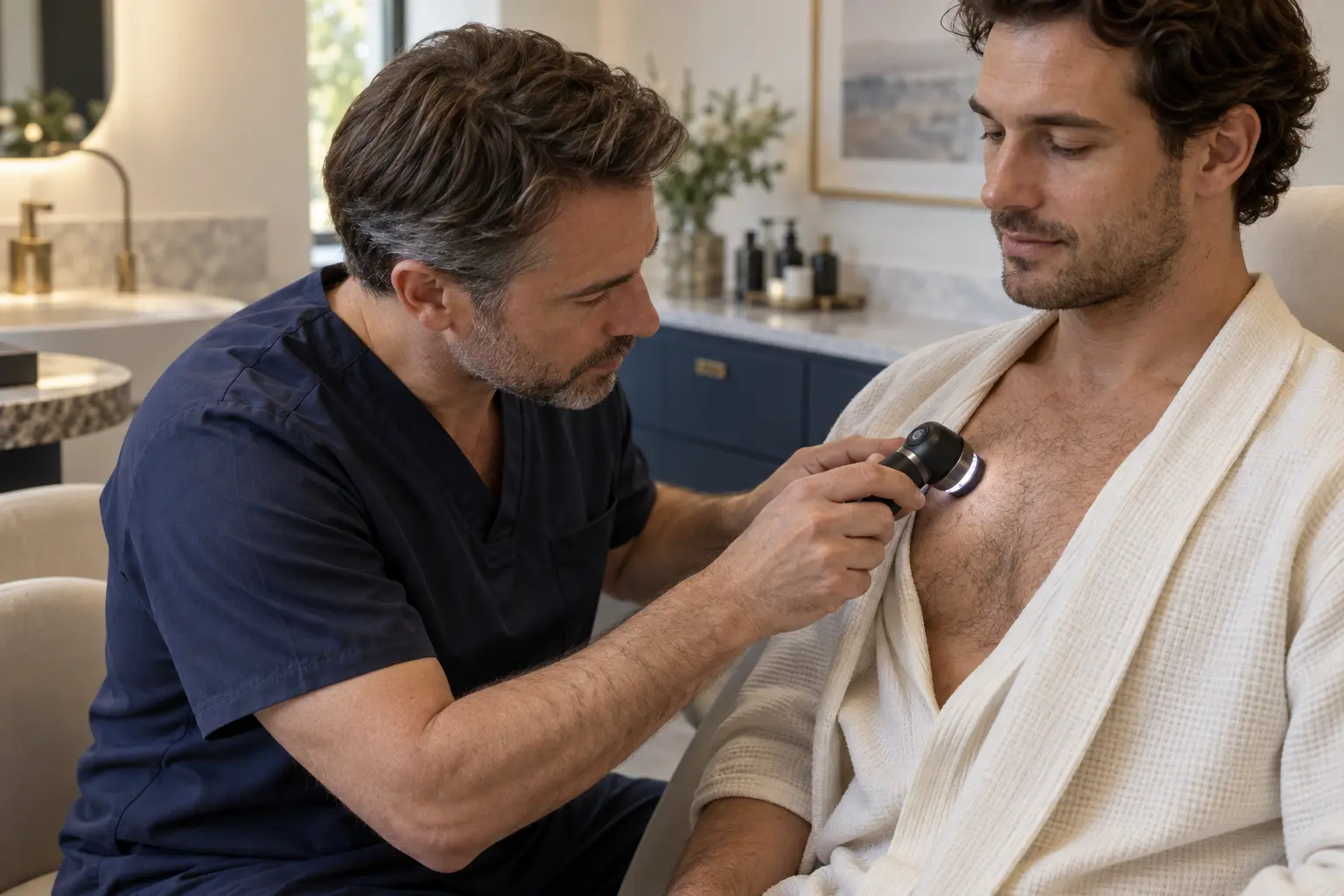
Every source behaves differently
Body hair is not one donor type.
Beard, chest, abdomen, arm and leg hair differ from one another—and from scalp hair—in calibre, curl, growth cycle, maximum length and how consistently they may grow after transfer.
“Body hair transplant” describes where grafts are harvested, not a new implantation method. Non-scalp follicles are removed individually using FUE. The clinical question is whether a particular source can make a useful, credible contribution to a defined recipient area.
Scalp hair
The usual first-choice source for scalp restoration because its growth and appearance provide the closest match.
Role: benchmark donorBeard hair
Often robust and coarse, usually harvested from beneath the jaw. It may add visual bulk but can contrast with fine, straight scalp hair.
Role: stronger secondary sourceChest or torso hair
Density, length, cycle, curl and growth after transfer vary markedly. Careful selection—and sometimes testing—may be appropriate.
Role: selected supplementary sourceArm, leg or other hair
Often finer and shorter with limited coverage value. These areas are not interchangeable reservoirs for routine scalp restoration.
Role: uncommon or specialist useWhen a big graft number hides a weak plan.
Body-hair surgery should not be sold as an unlimited solution to a depleted scalp donor. These are reasons to slow down and reassess.
The procedure, made clear
Body-hair transplantation is FUE from a different donor source.
Selected non-scalp follicular units are harvested one by one and placed into planned recipient sites, usually on the scalp. The extraction is technically demanding because body follicles can change direction beneath the skin.
Transplanted follicles largely retain donor-source characteristics. Beard hair may remain coarser and curlier; torso hair may remain shorter, finer or slower-growing. A thoughtful plan uses those differences deliberately and may combine sources rather than treating them as identical.
Candidate selection
A reserve donor is useful only when it strengthens the whole plan.
The decision depends on the pattern of loss, previous surgery, remaining scalp donor, non-scalp hair quality, recipient goal and tolerance for a staged or less predictable result.
Body hair may be considered when…
Surgery may be unsuitable or premature when…
The assessment pathway
Map the donor sources before designing the recipient area.
Not every patient needs body-hair surgery. The assessment should show whether non-scalp grafts add meaningful value beyond scalp donor preservation and non-surgical options.
Confirm diagnosis and progression
We review the cause and extent of loss, age, family history, scalp health, previous treatments and the likely long-term pattern.
Audit previous surgery
Donor scars, extraction patterns, recipient density, graft direction and records from earlier procedures are reviewed where available.
Measure the scalp donor
Remaining density, miniaturisation, calibre, safe boundaries and the effect of any further scalp harvesting are assessed first.
Map each non-scalp source
Beard and torso zones are evaluated separately for density, single- versus multi-hair units, direction, skin contrast and scar visibility.
Compare hair characteristics
Calibre, curl, colour, maximum length and likely growth cycle are compared with the scalp hair and the intended recipient zone.
Plan testing or staging
Where growth or appearance is uncertain, a small test may be discussed before a larger operation. Limitations, risks and alternatives form part of consent.
Comparing secondary sources
Beard and torso hair have different jobs.
Neither source should be valued by graft count alone. The visual contribution depends on shaft thickness, colour contrast, curl, growth length, cycle and how well it blends with the remaining scalp hair.
Important: non-scalp donor hair is harvested by FUE. It is not obtained by FUT, and it is not a scarless or predictable substitute for scalp grafts.
Beard to scalp
Usually harvested from a less visible under-jaw area and blended into selected scalp zones.
Torso to scalp
Selected chest or abdominal follicles may supplement a plan when their characteristics are useful.
Placement follows hair character
Different grafts belong in different zones.
Frontal hairline
The visible edge usually needs appropriate fine scalp hairs. Coarse beard or mismatched body hair is generally not used alone to create this transition.
Mid-scalp and crown
Selected beard hair may add visual bulk behind scalp grafts. Direction, curl and colour contrast still determine whether blending is credible.
Repair and scar areas
Body hair may contribute to selected repairs, but scar blood supply, previous damage, spacing and uncertain growth often favour conservative staging.
If surgery is appropriate
A treatment day built around more than one skin and hair type.
Duration and graft numbers vary. Your written consent should explain which source is being used, who performs each surgical stage, where scars may sit and how follow-up works.
Confirm sources and design
The selected donor zones, recipient areas, graft range, blend strategy, limitations and material risks are reviewed before proceeding.
Prepare growing donor hairs
Donor zones are trimmed or shaved according to the plan. Body hair direction and the proportion of actively growing hairs can influence selection.
Anaesthetise and harvest
Local anaesthetic injections can sting. Individual follicles are excised by FUE with technique adapted to the donor skin and changing hair angles.
Inspect and organise grafts
Grafts are handled, counted and separated by source and characteristics so placement can support the agreed blend.
Create sites and place grafts
Recipient sites are planned for direction, angle, distribution and source type. Body hair may be mixed behind suitable scalp grafts.
Aftercare for both areas
Written advice covers recipient protection, scalp and body donor care, washing, activity, medicines, warning signs and follow-up.
Recovery and growth
Two healing areas. A longer test of growth.
Your own surgeon’s instructions take priority. These phases are broad guideposts rather than promises; beard, torso and scalp sites can heal and grow at different rates.
0–2
Protect both sites
Tenderness, tightness, swelling, pinpoint bleeding or altered sensation can occur at the donor and recipient areas.
3–7
Early wound healing
Small crusts and redness remain. Washing, clothing contact and activity resume only according to written instructions.
1–2
Donor marks settle
Extraction dots become less prominent, but pigment change, redness or texture can remain visible for longer depending on skin type.
2–8
Shedding can occur
Transplanted shafts commonly shed. Temporary spots, folliculitis-like bumps or ingrown hairs may occur in donor or recipient areas.
3–6
Early growth
Growth may appear uneven and differ by donor source. An early change does not establish final yield, length or cosmetic value.
MTH
Longer assessment
Coverage, calibre and blending are judged over time. Body hair may remain shorter or different in texture from surrounding scalp hair.
Understand the possible complications.
Body-hair transplantation is surgery across separate anatomical sites. Risks depend on the source, skin type, extraction pattern and recipient plan.
Contact the clinic promptly if pain, redness, swelling, discharge, fever or other symptoms are increasing or unexpected.
Beyond the graft count
The same number of grafts can deliver very different coverage.
A body-hair plan must translate follicle numbers into realistic visual value, while preserving every donor site for the future.
Count hairs, not just grafts
Body follicular units are often single-haired, while scalp grafts can contain multiple hairs. Equal graft counts may not create equal coverage.
Respect the growth cycle
Torso hair may spend longer resting and reach a shorter length than scalp hair, so density on the skin does not predict scalp coverage.
Protect visible donor skin
Beard and chest sites can be exposed by shaving or clothing. Extraction spacing and scar contrast matter beyond the recipient result.
Keep future options open
Progressive scalp loss may continue. A conservative, staged plan avoids exhausting several donor sources for one short-term goal.
Clinical continuity
A rescue strategy should still be conservative.
Your consultation should identify who audits each donor zone, who makes FUE and recipient-site incisions, how different graft sources will be blended and when no further surgery is the safer advice.
Dr Fida Ul Haq
Hair restoration surgeon
Dr M Muhammad
Lead hair transplant surgeon
Our principle: a consultation may lead to medical stabilisation, scalp-only surgery, a small test, a combined-source plan, camouflage, a hair system or a recommendation not to proceed. More donor sites do not automatically mean more useful hair.
Questions worth asking
Clear answers before using a reserve donor.
These are general explanations, not personal medical advice. Suitability can only be decided after assessment.
What is a body hair transplant?
It uses FUE to harvest selected non-scalp follicles—most commonly from the beard and sometimes the chest or torso—and place them into a planned recipient area such as the scalp. It is usually a supplementary or rescue donor strategy.
When is body hair considered for scalp restoration?
It may be considered when the safe scalp donor supply is limited, depleted by previous surgery or insufficient for a defined repair or coverage goal. A complete scalp-donor assessment should come first.
Which body-hair donor source is usually preferred?
Where suitable, beard hair is often the stronger secondary source because it is generally more robust than other body hair. Chest or torso hair can be considered in selected patients, but growth, calibre and yield are more variable.
Will transplanted body hair grow like scalp hair?
Not necessarily. It largely retains characteristics of its donor source, including differences in calibre, curl, growth cycle and maximum length. Some change may occur after transplantation, but scalp-like behaviour cannot be promised.
Can body hair be used to create the frontal hairline?
Body hair is generally not used alone to build a highly visible frontal edge because texture and growth may not match. Selected finer hairs may sometimes be blended behind suitable scalp hairs as part of an individual plan.
Does body-hair FUE leave scars?
Yes. Each extraction creates a small wound that heals with a dot scar. Visibility varies with skin type, donor site, punch size, healing and extraction density. Pigment change and donor thinning are also possible.
Why might a test session be recommended?
A small staged procedure may help assess how a non-scalp donor source grows, looks and heals before committing to a larger operation. It cannot guarantee the outcome of later surgery.
How much does a body hair transplant cost?
Cost depends on the donor source, extraction difficulty, treatment area, complexity and responsible graft estimate after assessment. Your written quote should explain what is included, aftercare arrangements and finance terms. Check the clinic’s current pricing page rather than relying on an old headline price.
A consultation, not a commitment
Start with the donor map—not the graft target.
Meet the clinical team in Macclesfield to review the diagnosis, previous surgery, remaining scalp donor, beard and torso characteristics, recipient priorities and realistic alternatives.
This page provides general information and is not a diagnosis, personalised treatment recommendation or guarantee of outcome.