Widened FUT scar
Follicular unit transplantation (FUT) leaves a linear donor scar. Width can be influenced by closure tension, scalp characteristics, healing and further surgery.
Assess: width, laxity, hair lengthHair-transplant scar repair · Macclesfield
Hair-transplant scar repair is not one procedure. Depending on the scar and donor reserve, a plan may involve surgical revision, follicular grafting into or around stable scar tissue, scalp micropigmentation (SMP), or a staged combination. The aim is improvement—not erasure or guaranteed growth.
An assessment may lead to observation, treatment of an active condition, scar revision, grafting, SMP, a combined plan, specialist referral—or no procedure.
Classify before correcting
Width, colour, contour, symptoms, hair length and surrounding density all change what is visible—and which intervention, if any, is reasonable.
A pale line after strip surgery needs a different assessment from overharvested FUE, raised recipient-site texture or an inflammatory scarring disorder. The original cause must be understood before the appearance is treated.
Follicular unit transplantation (FUT) leaves a linear donor scar. Width can be influenced by closure tension, scalp characteristics, healing and further surgery.
Assess: width, laxity, hair lengthFollicular unit excision (FUE) leaves many small extraction scars. Dense or uneven harvesting can also reduce donor coverage and create a moth-eaten appearance.
Assess: pattern, reserve, contrastPitting, ridging, cobblestoning, pluggy growth or an unnatural hairline may need a repair plan that addresses design and texture—not simply more grafts.
Assess: contour, angle, old graftsTrauma, burns, other operations and inflammatory scarring alopecias behave differently. Active or uncertain disease requires specialist diagnosis before cosmetic work.
Assess: cause, activity, tissue qualityNHS guidance is clear that scars cannot be completely removed. A responsible proposal defines the visible feature it aims to improve and the trade-off it introduces.
What repair can mean
Scar repair is an umbrella term. Excision and re-closure alter the scar itself; grafting and SMP reduce how strongly it contrasts with the surrounding scalp. Each leaves a different footprint and none guarantees invisibility.
Scar tissue may be stiffer and less vascular than unscarred scalp, so follicle survival and final density can be less predictable. A surgical revision creates a new closure that can widen again. SMP adds pigment but does not add hair or correct contour.
Candidate selection
Readiness depends on the cause, maturity and behaviour of the scar—not one universal waiting period. Where inflammatory scarring alopecia is suspected, diagnosis and documented disease control are condition-specific and may require dermatology input.
A six-part assessment
A useful consultation should identify why the scar is visible, what has already been tried and which option offers the best balance of improvement, risk and future flexibility.
The original procedure or injury, timing, healing, symptoms, previous revisions, medical conditions, medicines and scarring history are documented.
Width, length, colour, contour, firmness, mobility, tenderness and the effect of hair length and lighting are recorded with standardised photographs.
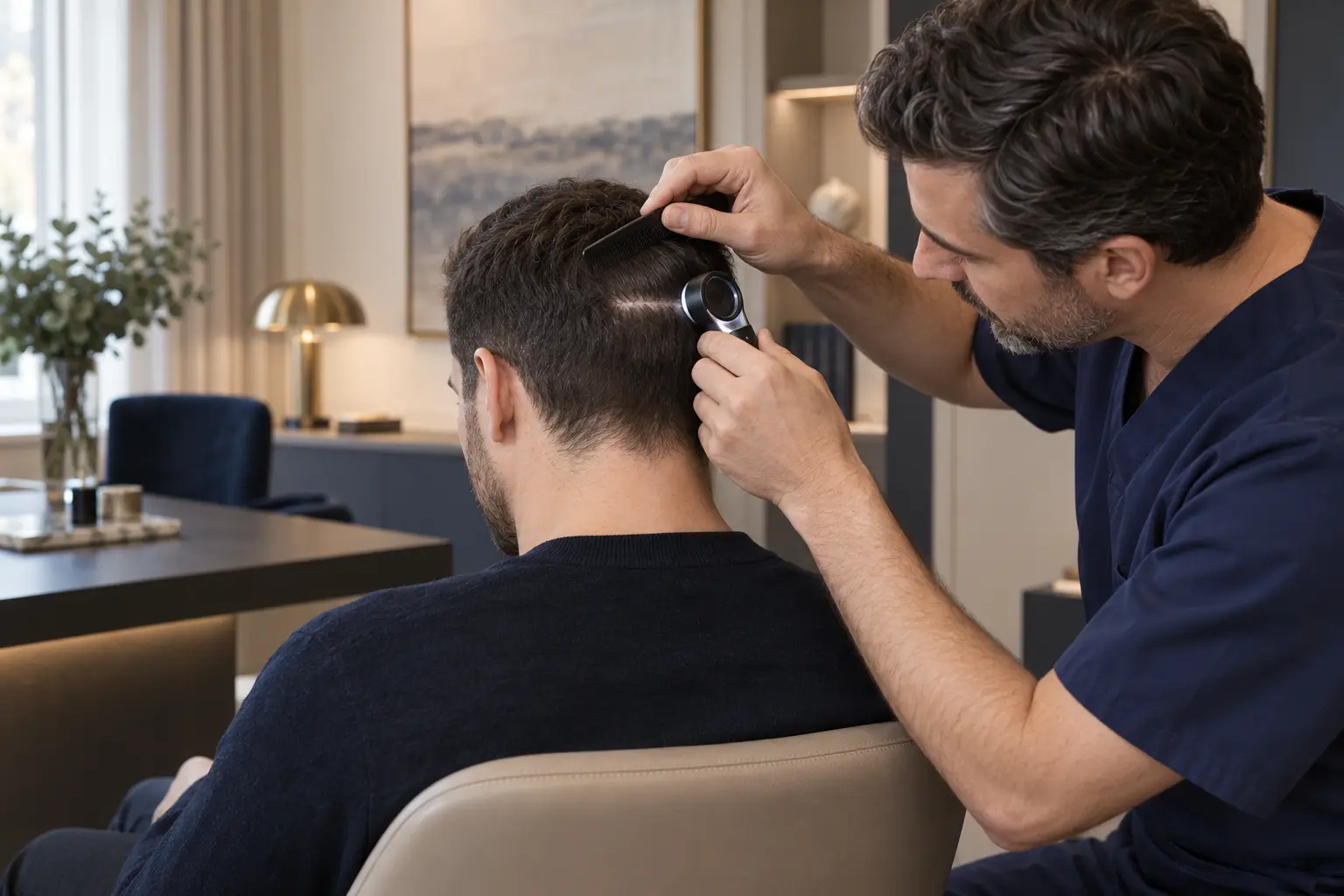
Magnified scalp examination looks for inflammation, scale, perifollicular change and progressive loss. Suspicious findings may require specialist investigation.
Scar maturity, thickness, vascular appearance and surrounding hair are considered alongside donor density, calibre, miniaturisation and previous harvest pattern.
Observation, styling, camouflage, SMP, surgical revision, follicular grafting, a test area, combined treatment and no intervention are compared.
The proposed endpoint, number of stages, donor cost, material risks, aftercare, review points and response to limited improvement are agreed before treatment.
Two surgical routes
Some scars are better camouflaged; others may be candidates for excision and re-closure. The routes can also be sequenced—for example, revision first and grafting after the new scar has matured—when a clinician believes the combined trade-off is worthwhile.
Where SMP fits: scalp micropigmentation is a non-surgical camouflage option that reduces contrast rather than changing scar tissue or adding hair. Pigment colour, fade, migration and behaviour within scar tissue should be discussed.
Selected follicular units are harvested—commonly by FUE for a localised repair—and placed into or around stable scar tissue.
A selected scar is excised and the wound re-closed to seek a narrower or better-positioned line.
Three strategy decisions
A pale line, missing hair, raised texture and an overharvested donor each need a different endpoint. “Make it disappear” is not a usable plan.
Longer hair may cover a linear scar; short hair may favour pigment camouflage. Direction, calibre and contrast shape grafting decisions.
When growth or healing is uncertain, a test area or conservative first stage can provide information before more donor or tissue is committed.
If follicular grafting is selected
The exact sequence depends on the scar and harvest method. Consent should identify the operating surgeon, each team member’s role, the planned donor area, an estimated graft range, risks, aftercare and the possibility of limited growth or staged treatment.
The diagnosis, scar boundaries, tissue findings, donor map, hair direction, photographs and agreed improvement target are checked.
The treatment areas are prepared and local anaesthetic is administered. Any additional medicine or sedation must be individually assessed and explained.
Follicular units are removed by the agreed FUE or, in selected plans, FUT approach without treating the donor as an unlimited supply.
Recipient sites are planned around existing hair, scar thickness, contour and vascularity. Excessive density can compromise tissue and graft survival.
Appropriate grafts are placed with attention to angle, direction, spacing and minimal trauma, then donor and recipient areas are rechecked.
Written wound care, medicines, warning signs, contact details and review milestones are provided, including when a second stage could be considered.
Healing and maturation
These phases describe follicular grafting or surgical revision in broad terms. Follow the treating clinician’s written instructions; closure care, graft care and SMP aftercare are not interchangeable.
Tenderness, redness, pinpoint crusting, minor oozing or tightness can occur. Avoid rubbing, pressure and products not approved by the treatment team.
Grafts and donor sites continue to settle. A revised closure may need different cleansing, dressing and activity instructions from a grafted scar.
Crusting and redness usually evolve gradually. Sutures or staples, if used, are reviewed or removed on the surgeon’s individual schedule.
Transplanted shafts commonly shed. Colour, firmness and sensation can change while the scar continues to remodel.
New hair may begin at different times and can initially look fine or uneven. An early photograph cannot establish final survival or density.
Growth, calibre, scar maturation and camouflage can continue to evolve. A second stage is considered only after enough healing can be judged.
Scar repair can trade one visible problem for another. Careful selection reduces avoidable risk but cannot guarantee healing, graft growth or satisfaction.
Contact the treatment team promptly for severe or increasing pain, active bleeding, marked swelling, spreading redness, discharge, fever, wound separation, breathing difficulty, visual symptoms or any unexpected deterioration.
A repair plan, not a quick cover-up
The strongest plan treats active disease first, chooses a proportionate endpoint and preserves options if healing, pigment or graft growth differs from expectation.
Inflammation, infection or progressive scarring is a medical problem first. Cosmetic work should not mask an undiagnosed active condition.
Hair length, styling, camouflage or SMP may sometimes meet the goal without another incision or further donor harvesting.
Repair grafts come from the same reserve that may be needed for future hair loss or correction elsewhere on the scalp.
Agree in advance how the result will be documented, when it can be judged and what options remain if improvement is modest.
Your clinical team
Scar repair combines medical diagnosis with decisions that can create further scarring or consume more donor hair. Your plan should identify responsibility for assessment, incision or extraction, recipient-site creation, closure, placement and follow-up.
Hair-loss and scalp assessment; long-term planning
Lead hair transplant surgeon; repair strategy
Before you decide: verify each clinician’s current registration and role, ask who performs every treatment stage, and take time to consider the diagnosis, alternatives, donor cost, material risks, price and likely residual visibility without pressure.
Questions worth asking
These are general explanations, not personal medical advice. Suitability requires examination of the scar, scalp and donor area.
No treatment can promise to remove a scar completely. Surgical revision may exchange a wide scar for a new closure, while follicular grafting or SMP may reduce contrast. The responsible aim is a defined improvement in width, contour or visibility—not normal unscarred skin.
Sometimes. Mature, stable scar tissue may accept follicular grafts, but stiffness and reduced vascularity can make growth less predictable than in unscarred scalp. Suitability, density and whether to use a test area or staged approach depend on examination.
Options may be considered for widened FUT linear scars, visible FUE dot scarring or overharvesting, and selected recipient-site problems such as pitting or pluggy growth. The cause, scar maturity, tissue quality, surrounding hair and donor reserve determine what is reasonable.
FUE is often considered when a limited number of grafts are needed to camouflage a scar because it avoids another linear donor incision, but it still creates extraction scars. FUT may be relevant in selected broader plans. The harvest route should follow donor anatomy, prior surgery and long-term reserve.
It can be. Scalp micropigmentation places pigment to reduce colour contrast; it does not add hair or correct raised, depressed or tight tissue. Hair length, skin and hair colour, scar behaviour, pigment fade and the possibility of maintenance all matter.
There is no reliable number from a photograph alone. Scar dimensions, tissue quality, existing hair, calibre, contrast, preferred haircut, donor reserve and a conservative site density all affect the proposed range. Some cases are staged or begin with a test area.
After grafting, transplanted shafts often shed before new growth begins over subsequent months, with maturation assessed broadly around 10 to 18 months. A revised scar also remodels for months. SMP has a different healing and review schedule set by the practitioner.
Cost depends on diagnosis, scar size and complexity, the selected route, graft range where relevant, number of stages, operating team, facility and aftercare. A written quote should separate revision, grafting and SMP costs and explain possible additional treatment.
A consultation, not a commitment
Meet the clinical team in Macclesfield for scar classification, magnified scalp and donor assessment, treatment comparison and a realistic discussion of likely improvement, residual visibility and long-term options.
This page provides general information and is not a diagnosis, personalised treatment recommendation or guarantee of outcome.